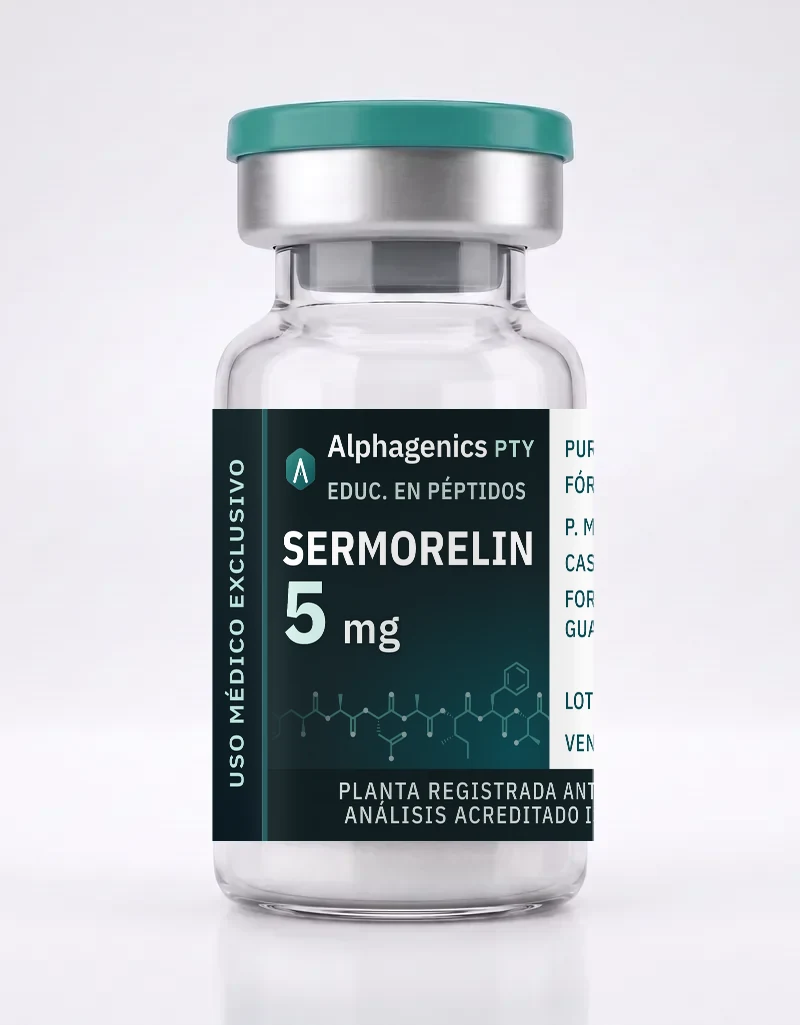
Sermorelin
GHRH (1-29)-NH2 · GRF 1-29
Growth hormone-releasing hormone (GHRH) analog
About Sermorelin
Sermorelin corresponds to the first 29 amino acids of human growth hormone-releasing hormone (GHRH), the shortest fragment that retains full biological activity.
It acts on the GHRH receptor in the anterior pituitary, stimulating the synthesis and pulsatile release of endogenous growth hormone (GH), which in turn regulates hepatic IGF-1 production. It was approved by the FDA in 1990 as a diagnostic test of the ability of the pituitary to secrete GH, and in 1997 for the treatment of idiopathic GH deficiency in children with growth failure. The manufacturer discontinued it in 2008, and the FDA determined that it was not withdrawn for reasons of safety or effectiveness.
Quick guide · 5 key points
Sermorelin: the active fragment of GHRH
Sermorelin copies the hypothalamus's natural signal that tells the pituitary to release growth hormone (GH). Here are five things the research shows.
-
1
The shortest fragment with full activity
Sermorelin is the first 29 amino acids of human GHRH, the shortest synthetic peptide with the hormone's full biological activity. It has been shown to specifically stimulate GH secretion from the anterior pituitary.1
29 aaGHRH fragment with full biological activity -
2
Growth in children with GH deficiency
In a 1-year open-label study of 110 prepubertal children with GH deficiency, once-daily sermorelin was associated with growth velocity rising from 4.1 to 7.2 cm/year at 12 months, with no adverse changes in lab tests.2
4.1 → 7.2cm/year growth velocity at 12 months -
3
GH and IGF-1 in older men
In 10 healthy older men, 14 days of GHRH (1-29) at the study's higher dose brought GH and IGF-1 back to levels seen in young men. With [Nle27]GHRH(1-29)-NH2, a GHRH analog, for 16 weeks in adults aged 55 to 71, IGF-1 rose and returned toward baseline by week 16; lean mass increased in men only.3,4
14 daysTo match the GH and IGF-1 of young men -
4
Signals in cognitive function
In a placebo-controlled trial in 89 healthy older adults, 6 months of daily GHRH was associated with better performance on several cognitive tests, regardless of sex or baseline cognitive ability. This is a single trial, and the abstract does not specify the form of GHRH used.5
89Older adults in the 6-month placebo-controlled trial -
5
FDA-approved molecule, now discontinued
Sermorelin (Geref®) was approved by the FDA in 1990 and, in a new dosage form, in 1997. It is no longer marketed, and the FDA determined it was not withdrawn for safety or effectiveness reasons. The side effects reported most often in studies were brief facial flushing and injection-site pain.6,7,1
1997FDA approval of the Geref® vial dosage form
References
- Prakash A, Goa KL. Sermorelin: a review of its use in the diagnosis and treatment of children with idiopathic growth hormone deficiency. BioDrugs. 1999;12(2):139-57. PMID 18031173
- Thorner M, et al. Once daily subcutaneous growth hormone-releasing hormone therapy accelerates growth in growth hormone-deficient children during the first year of therapy. J Clin Endocrinol Metab. 1996;81(3):1189-96. PMID 8772599
- Corpas E, et al. Growth hormone (GH)-releasing hormone-(1-29) twice daily reverses the decreased GH and insulin-like growth factor-I levels in old men. J Clin Endocrinol Metab. 1992;75(2):530-5. PMID 1379256
- Khorram O, et al. Endocrine and metabolic effects of long-term administration of [Nle27]growth hormone-releasing hormone-(1-29)-NH2 in age-advanced men and women. J Clin Endocrinol Metab. 1997;82(5):1472-9. PMID 9141536
- Vitiello MV, et al. Growth hormone releasing hormone improves the cognition of healthy older adults. Neurobiol Aging. 2006;27(2):318-23. PMID 16399214
- U.S. Food and Drug Administration. Drugs@FDA: Geref (sermorelin acetate), NDA 020443 (approved 1997; discontinued; Federal Register determination that it was not withdrawn for safety or effectiveness reasons). Official source
- U.S. Food and Drug Administration. Drugs@FDA: Geref (sermorelin acetate), NDA 019863 (approved 1990). Official source
Structure and sequence
Sequence
Large molecule (3357.9 g/mol): the full structure is shown above; the sequence summarizes its amino-acid order. 3D model available on PubChem.

Five findings from studies
Summary of results reported in the scientific literature. Each finding describes what was observed in the cited study, in its specific population and conditions; it does not constitute a therapeutic indication.
-
Clinical study
In a single-blind, placebo-controlled study in 19 men and women aged 55 to 71, nightly administration of [Nle27]GHRH(1-29)-NH2 (a GHRH analog, not sermorelin itself) for 16 weeks has shown an increase in nocturnal GH; IGF-1 rose by week 2, stayed elevated for 12 weeks and returned toward baseline by week 16. Lean mass increased in the men only.
Khorram O et al. J Clin Endocrinol Metab. 1997;82:1472-1479 · PMID 9141536 -
Clinical study
In 10 healthy older men, 14 days of subcutaneous GHRH (1-29) twice daily, at the higher dose, has raised 24-hour GH and IGF-1 to values not significantly different from those of young men.
Corpas E et al. J Clin Endocrinol Metab. 1992;75:530-535 · PMID 1379256 -
Clinical study
In prepubertal children with GH deficiency (110 patients, 1-year open-label study), once-daily sermorelin (GHRH 1-29) has shown an increase in growth velocity from 4.1 to 7.2 cm/year at 12 months.
Thorner M et al. J Clin Endocrinol Metab. 1996;81:1189-1196 · PMID 8772599 -
Clinical study
In a placebo-controlled trial in 89 healthy older adults (men and women), 6 months of daily GHRH treatment has been associated with improvements on some cognitive tests. The abstract does not specify the form of GHRH used.
Vitiello MV et al. Neurobiol Aging. 2006;27:318-323 · PMID 16399214 -
Review
According to an opinion article, unlike exogenous GH, sermorelin stimulates endogenous GH secretion by the pituitary, so its effect remains subject to negative feedback by somatostatin.
Walker RF. Clin Interv Aging. 2006;1:307-308 · PMID 18046908