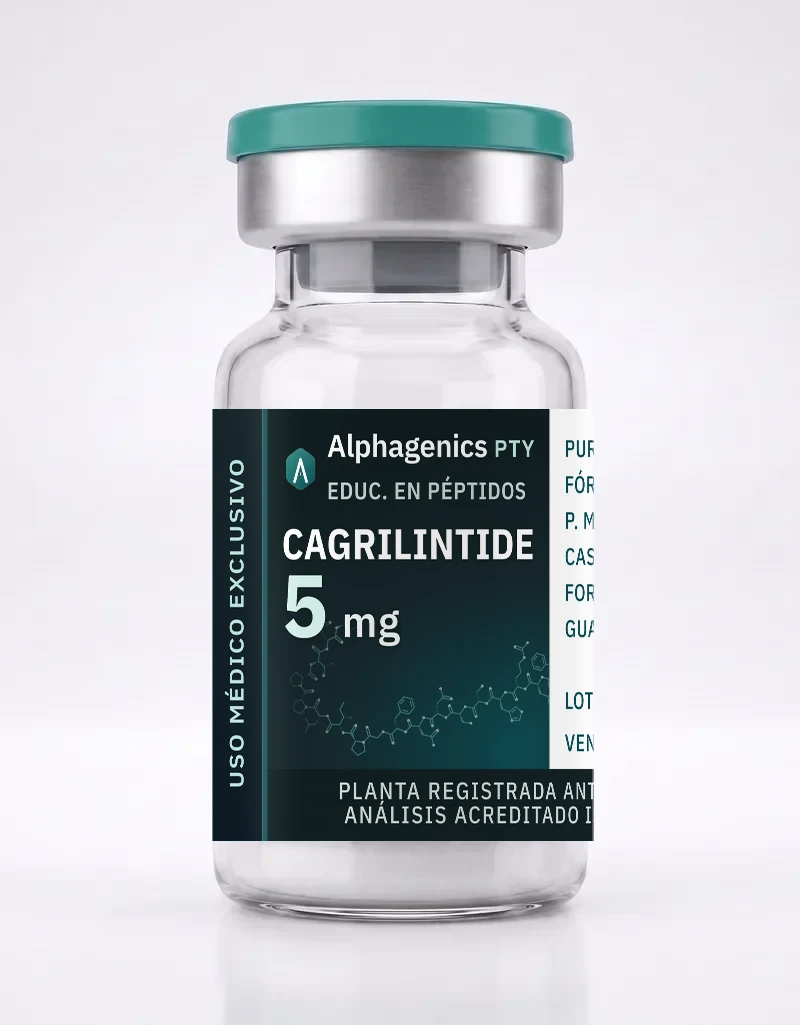
Cagrilintide
NN9838
Long-acting amylin analog (amylin and calcitonin receptor agonist)
About Cagrilintide
Cagrilintide is an acylated analog of amylin, a hormone that pancreatic β-cells release together with insulin and that takes part in the satiety signal, gastric emptying and the regulation of postprandial glucagon.
Its lipid chain allows once-weekly administration. It acts on amylin (AMY) and calcitonin receptors, and is being studied alone and in combination with semaglutide (a combination known as CagriSema).
Quick guide · 5 key points
Cagrilintide: the amylin pathway
Cagrilintide is a long-acting analog of amylin, a pancreatic hormone that signals fullness. Here are five things the research shows.
-
1
A stable, long-acting amylin
Amylin is a pancreatic hormone that induces satiety, but it tends to form amyloid fibrils, which makes it hard to turn into a drug. Cagrilintide is a stable, lipidated analog developed for long-lasting action.1,2
PramlintideShort half-life amylin analog: needs three injections a day.CagrilintideLong-acting lipidated analog, studied as a once-weekly injection. -
2
Weight loss on its own in phase 2
In a phase 2 trial (adults with obesity or overweight, without diabetes, 26 weeks; 706 received cagrilintide), the 4.5 mg dose was associated with an average weight reduction of 10.8%, compared with 3.0% on placebo, and more than with liraglutide 3.0 mg (9.0%).2
−10.8%Average weight change at 4.5 mg (placebo: −3.0%) -
3
With semaglutide: over 20% in phase 3
In the phase 3 REDEFINE 1 trial (3,417 adults with obesity or overweight, 68 weeks), the cagrilintide-semaglutide combination (2.4 mg each) was associated with an average weight reduction of 20.4%, compared with 3.0% on placebo. In REDEFINE 2 (1,206 adults with type 2 diabetes) it was 13.7%, versus 3.4%.3,4
−20.4%Average weight change in REDEFINE 1 (68 weeks) -
4
Why it is combined with semaglutide
In a phase 2 trial (92 adults with type 2 diabetes, 32 weeks), the combination was associated with 15.6% weight loss, more than semaglutide alone (5.1%) or cagrilintide alone (8.1%). The HbA1c reduction was greater than with cagrilintide alone, but not significantly greater than with semaglutide.5
−15.6%Weight change with the combination over 32 weeks -
5
Side effects are mostly digestive
In the phase 2 trial, the most common side effects were gastrointestinal (nausea in 20–47%, versus 18% on placebo) and injection-site reactions. In REDEFINE 1, gastrointestinal effects were reported in 79.6% with the combination (39.9% on placebo), mostly short-lived and mild to moderate.2,3
79.6%Digestive effects with the combination in REDEFINE 1 (placebo: 39.9%)
References
- Kruse T, et al. Development of cagrilintide, a long-acting amylin analogue. J Med Chem. 2021;64(15):11183-94. PMID 34288673
- Lau DCW, et al. Once-weekly cagrilintide for weight management in people with overweight and obesity: a multicentre, randomised, double-blind, placebo-controlled and active-controlled, dose-finding phase 2 trial. Lancet. 2021;398(10317):2160-72. PMID 34798060
- Garvey WT, et al. Coadministered cagrilintide and semaglutide in adults with overweight or obesity. N Engl J Med. 2025;393(7):635-47. PMID 40544433
- Davies MJ, et al. Cagrilintide-semaglutide in adults with overweight or obesity and type 2 diabetes. N Engl J Med. 2025;393(7):648-59. PMID 40544432
- Frias JP, et al. Efficacy and safety of co-administered once-weekly cagrilintide 2.4 mg with once-weekly semaglutide 2.4 mg in type 2 diabetes: a multicentre, randomised, double-blind, active-controlled, phase 2 trial. Lancet. 2023;402(10403):720-30. PMID 37364590
Structure and sequence
Sequence
37-residue amylin analog with a Cys2–Cys7 disulfide bridge, stabilizing prolines and N-terminal acylation with a C20 fatty acid.
Large molecule (4409.0 g/mol): the full structure is shown above; the sequence summarizes its amino-acid order. 3D model available on PubChem.

Five findings from studies
Summary of results reported in the scientific literature. Each finding describes what was observed in the cited study, in its specific population and conditions; it does not constitute a therapeutic indication.
-
Clinical study
In a phase 2 dose-finding trial (906 adults with obesity or overweight without diabetes, 706 of them assigned to cagrilintide; 26 weeks), cagrilintide 4.5 mg has shown a mean body-weight reduction of 10.8%, versus 3.0% with placebo.
Lau DCW et al. Lancet. 2021;398:2160-2172 · PMID 34798060 -
Clinical study
In the REDEFINE 1 trial (68 weeks), the cagrilintide-semaglutide combination has shown a mean body-weight reduction of 20.4%, versus 3.0% with placebo.
Garvey WT et al. N Engl J Med. 2025;393:635-647 (REDEFINE 1) · PMID 40544433 -
Clinical study
In the REDEFINE 2 trial, in adults with type 2 diabetes and obesity, the combination has shown a mean body-weight reduction of 13.7%, versus 3.4% with placebo.
Davies MJ et al. N Engl J Med. 2025;393:648-659 (REDEFINE 2) · PMID 40544432 -
Clinical study
In a phase 2 trial (92 patients with type 2 diabetes, 32 weeks), the combination with semaglutide has shown an HbA1c reduction of 2.2 percentage points, significantly greater than with cagrilintide alone and numerically greater, although without a significant difference, than with semaglutide alone; the body-weight reduction was significantly greater than with each component separately.
Frias JP et al. Lancet. 2023;402:720-730 · PMID 37364590 -
Preclinical
In pharmacology studies, acylation has given cagrilintide a half-life compatible with once-weekly administration and agonist activity at amylin and calcitonin receptors.
Kruse T et al. J Med Chem. 2021;64:11183-11194 · PMID 34288673