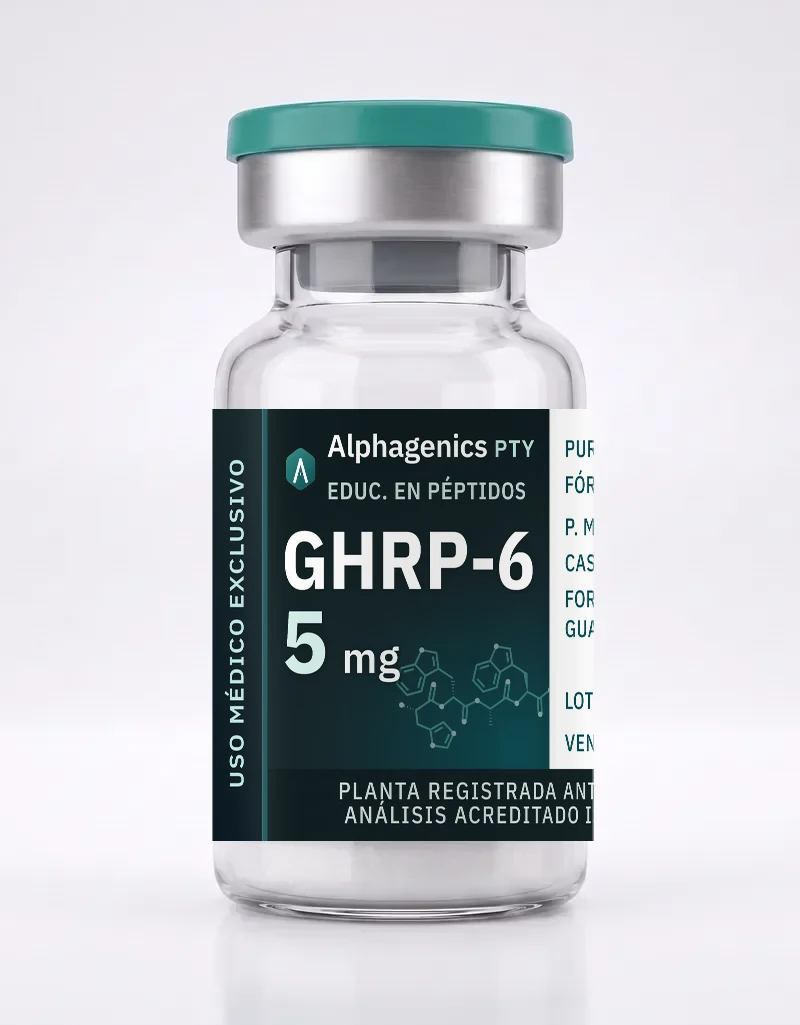
GHRP-6
GH-releasing peptide-6 · SKF-110679
GH-releasing hexapeptide, GHS-R1a agonist
About GHRP-6
GHRP-6 was one of the first growth hormone-releasing peptides to be synthesized, and its study led to the discovery of the GH secretagogue receptor (GHS-R1a) and, later, of ghrelin as its endogenous ligand.
It stimulates GH release synergistically with GHRH and, as a ghrelin-receptor agonist, acts on the same pathway through which ghrelin has been shown to increase appetite and food intake in humans.
Quick guide · 5 key points
GHRP-6: the peptide that led to ghrelin
GHRP-6 was one of the first synthetic growth hormone (GH)-releasing peptides, and studying it opened the door to the discovery of ghrelin. Here are five things the research shows.
-
1
A hexapeptide that releases GH specifically
In 1984 GHRP-6 was described as a synthetic hexapeptide that releases GH without releasing LH, FSH, TSH or prolactin in animal studies. In rats, after an intravenous injection, GH rose within 2 minutes and peaked at 10–20 minutes. It was active in rats, monkeys, lambs and calves.1
10–20 minTo peak GH after an intravenous dose, in rats -
2
Its receptor led to the discovery of ghrelin
In 1996 researchers cloned the receptor that GHRP-6 and other GH secretagogues act on, in the pituitary and hypothalamus, which pointed to a still-unknown hormone. In 1999 it was identified: ghrelin, a 28-amino-acid peptide made in the stomach.2,3
1999Discovery of ghrelin, the receptor's natural ligand -
3
Synergy with GHRH in healthy men
In 18 healthy men, intravenous GHRP-6 was associated with dose-dependent GH release, with a mean peak of 68.7 µg/L at the highest dose. Combined with GHRH at submaximal doses, GH release was synergistic, suggesting the two act through independent pathways.4
68.7 µg/LMean peak GH at the highest dose (1.2 on placebo) -
4
Heart protection in an animal model
In pigs with an induced acute heart attack, GHRP-6 was associated with a 78% smaller infarct mass and 50% thinner infarct vs saline, along with less oxidative stress. These are preclinical data, not studied in humans.5
−78%Infarct mass vs saline, in pigs -
5
Hormonal effects and appetite
No clinical adverse effects were seen in healthy men, but at the highest dose prolactin and cortisol rose about 2-fold. As a ghrelin-receptor agonist, it is linked to the appetite pathway: ghrelin has been shown to increase food intake by 28% in healthy volunteers.4,6
≈ 2×Rise in prolactin and cortisol at the highest dose
References
- Bowers CY, et al. On the in vitro and in vivo activity of a new synthetic hexapeptide that acts on the pituitary to specifically release growth hormone. Endocrinology. 1984;114(5):1537-45. PMID 6714155
- Howard AD, et al. A receptor in pituitary and hypothalamus that functions in growth hormone release. Science. 1996;273(5277):974-7. PMID 8688086
- Kojima M, et al. Ghrelin is a growth-hormone-releasing acylated peptide from stomach. Nature. 1999;402(6762):656-60. PMID 10604470
- Bowers CY, et al. Growth hormone (GH)-releasing peptide stimulates GH release in normal men and acts synergistically with GH-releasing hormone. J Clin Endocrinol Metab. 1990;70(4):975-82. PMID 2108187
- Berlanga J, et al. Growth-hormone-releasing peptide 6 (GHRP6) prevents oxidant cytotoxicity and reduces myocardial necrosis in a model of acute myocardial infarction. Clin Sci (Lond). 2007;112(4):241-50. PMID 16989643
- Wren AM, et al. Ghrelin enhances appetite and increases food intake in humans. J Clin Endocrinol Metab. 2001;86(12):5992. PMID 11739476
Structure and sequence
Sequence

Five findings from studies
Summary of results reported in the scientific literature. Each finding describes what was observed in the cited study, in its specific population and conditions; it does not constitute a therapeutic indication.
-
Preclinical
In the original studies, GHRP-6 has shown specific GH release in animal models, which established the class of peptide GH secretagogues.
Bowers CY et al. Endocrinology. 1984;114:1537-1545 · PMID 6714155 -
Clinical study
In human volunteers, a dose-dependent GH release has been observed, with a synergistic effect when combined with GHRH.
Bowers CY et al. J Clin Endocrinol Metab. 1990;70:975-982 · PMID 2108187 -
Preclinical
In a porcine model of acute myocardial infarction, GHRP-6 has been associated with a reduction in infarct size and oxidative damage.
Berlanga J et al. Clin Sci (Lond). 2007;112:241-250 · PMID 16989643 -
Preclinical
In 1996 the receptor on which GHRP-6 and the other GH secretagogues act was cloned, which indicated the existence of an as-yet-undiscovered endogenous hormone; in 1999 it was identified as ghrelin (Kojima M et al. Nature. 1999;402:656-660, PMID 10604470).
Howard AD et al. Science. 1996;273:974-977 · PMID 8688086 -
Clinical study
In 9 healthy volunteers, intravenous infusion of ghrelin (the natural ligand of the receptor GHRP-6 acts on) has been associated with a 28% increase in food intake at a free-choice buffet; this study did not test GHRP-6.
Wren AM et al. J Clin Endocrinol Metab. 2001;86:5992 · PMID 11739476