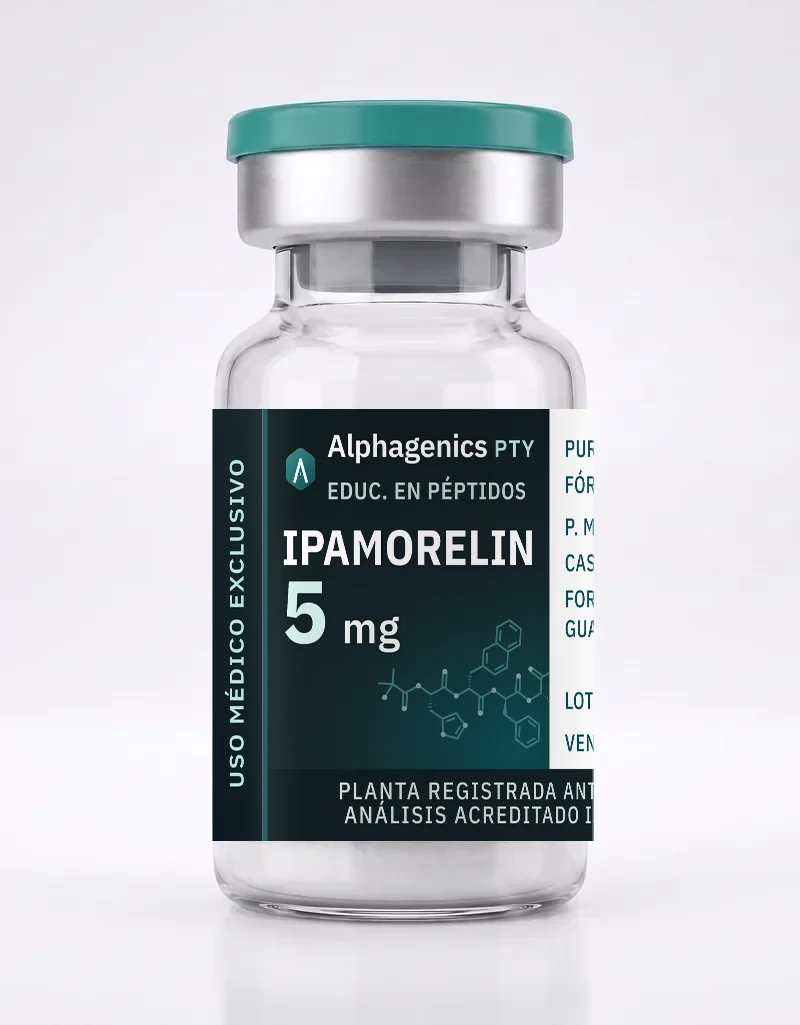
Ipamorelin
NNC 26-0161
GH secretagogue, ghrelin receptor (GHS-R1a) agonist
About Ipamorelin
Ipamorelin is a synthetic pentapeptide (Aib-His-D-2Nal-D-Phe-Lys-NH2) developed as an agonist of the growth hormone secretagogue receptor (GHS-R1a), the same receptor used by endogenous ghrelin.
It was described as the first selective GH secretagogue: in the initial studies it stimulated GH release without significantly raising ACTH or cortisol, unlike other first-generation GH-releasing peptides.
Quick guide · 5 key points
Ipamorelin: the selective GH secretagogue
Ipamorelin is a pentapeptide that triggers growth hormone (GH) release through the ghrelin receptor. Here are five things the research shows.
-
1
Releases GH without raising cortisol
Ipamorelin acts on the ghrelin receptor (GHS-R1a). In pigs it has been shown to release GH about as potently as GHRP-6, but unlike GHRP-6 and GHRP-2 it does not significantly raise ACTH or cortisol, even at doses more than 200 times those needed to release GH.1
GHRP-6 and GHRP-2Release GH and also raise ACTH and cortisol.IpamorelinReleases GH with selectivity similar to GHRH.> 200×The effective GH dose, with no significant cortisol rise -
2
Pharmacokinetics measured in healthy volunteers
In a study of healthy men at five intravenous dose levels, ipamorelin showed a terminal half-life of about 2 hours and a single GH peak at ~40 minutes (0.67 h), which then fell to negligible levels at every dose.2
≈ 2 hTerminal half-life in healthy volunteers -
3
Bone growth in rats
In adult female rats, 15 days of ipamorelin was associated with a dose-dependent increase in longitudinal bone growth. In another 12-week study, bone mineral content rose, explained by larger bones rather than higher volumetric mineral density.3,4
42 → 52µm/day bone growth at the highest dose, in rats -
4
Gut motility: from rats to phase 2
In a rat model of postoperative ileus, a dose of ipamorelin was associated with an earlier first bowel movement after surgery. In a phase 2 trial of 114 bowel-resection patients, time to tolerating a solid meal was 25.3 h vs 32.6 h on placebo, a non-significant difference.5,6
Phase 2No significant difference vs placebo in postoperative ileus -
5
Well tolerated, with limited human evidence
In the phase 2 trial ipamorelin was well tolerated: adverse events occurred in 87.5% of patients on ipamorelin and 94.8% on placebo. Beyond that trial and the pharmacokinetic studies, most of the data come from animal studies.6,2,1
87.5%Adverse events on ipamorelin, vs 94.8% on placebo
References
- Raun K, et al. Ipamorelin, the first selective growth hormone secretagogue. Eur J Endocrinol. 1998;139(5):552-61. PMID 9849822
- Gobburu JV, et al. Pharmacokinetic-pharmacodynamic modeling of ipamorelin, a growth hormone releasing peptide, in human volunteers. Pharm Res. 1999;16(9):1412-6. PMID 10496658
- Johansen PB, et al. Ipamorelin, a new growth-hormone-releasing peptide, induces longitudinal bone growth in rats. Growth Horm IGF Res. 1999;9(2):106-13. PMID 10373343
- Svensson J, et al. The GH secretagogues ipamorelin and GH-releasing peptide-6 increase bone mineral content in adult female rats. J Endocrinol. 2000;165(3):569-77. PMID 10828840
- Venkova K, et al. Efficacy of ipamorelin, a novel ghrelin mimetic, in a rodent model of postoperative ileus. J Pharmacol Exp Ther. 2009;329(3):1110-6. PMID 19289567
- Beck DE, et al. Prospective, randomized, controlled, proof-of-concept study of the Ghrelin mimetic ipamorelin for the management of postoperative ileus in bowel resection patients. Int J Colorectal Dis. 2014;29(12):1527-34. PMID 25331030
Structure and sequence
Sequence

Five findings from studies
Summary of results reported in the scientific literature. Each finding describes what was observed in the cited study, in its specific population and conditions; it does not constitute a therapeutic indication.
-
Preclinical
In rat pituitary cells, rats and pigs, ipamorelin has shown GH release with potency and efficacy comparable to those of GHRP-6. In pigs, it did not raise ACTH or cortisol significantly compared with GHRH, even at doses more than 200 times the ED50 for GH, which defined it as the first selective GH secretagogue.
Raun K et al. Eur J Endocrinol. 1998;139:552-561 · PMID 9849822 -
Preclinical
In adult female rats, 15 days of ipamorelin has been associated with a dose-dependent increase in longitudinal bone growth (from 42 to 52 µm/day at the highest dose), with no change in total IGF-1.
Johansen PB et al. Growth Horm IGF Res. 1999;9:106-113 · PMID 10373343 -
Preclinical
In adult female rats, 12 weeks of ipamorelin has been associated with an increase in bone mineral content, explained by larger bones: volumetric mineral density and mineral content corrected for body weight did not change.
Svensson J et al. J Endocrinol. 2000;165:569-577 · PMID 10828840 -
Clinical study
In healthy men (intravenous infusion, five dose levels), ipamorelin has shown a terminal half-life of about 2 hours and a single episode of GH release, peaking at 0.67 h, at all doses.
Gobburu JV et al. Pharm Res. 1999;16:1412-1416 · PMID 10496658 -
Preclinical
In a rat model of postoperative ileus, a single dose of ipamorelin has been associated with a shorter time to the first bowel movement after surgery.
Venkova K et al. J Pharmacol Exp Ther. 2009;329:1110-1116 · PMID 19289567