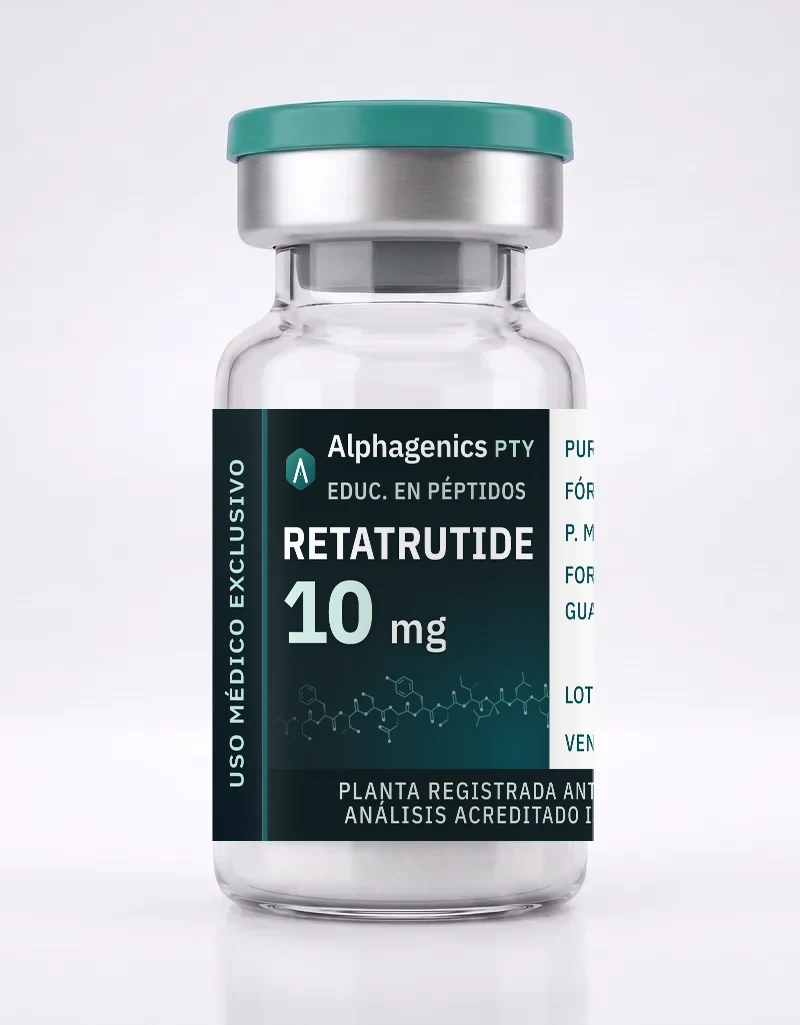
Retatrutide
LY3437943
Triple GIP, GLP-1 and glucagon receptor agonist
About Retatrutide
Retatrutide is a synthetic 39-amino-acid peptide that acts as a simultaneous agonist of three gut and pancreatic hormone receptors: GIP, GLP-1 and glucagon.
Activation of the glucagon receptor is being studied for its possible contribution to energy expenditure and hepatic lipid metabolism, complementing the effects of the other two pathways on appetite and glucose. It is conjugated to a fatty acid that allows once-weekly administration and is in phase 3 clinical development (TRIUMPH program), with the first results published in 2026.
Quick guide · 5 key points
Retatrutide: three receptors, one molecule
Retatrutide adds the glucagon pathway to the GIP and GLP-1 pathways. Here are five things the research shows.
-
1
Three hormone receptors with a single molecule
Retatrutide activates the glucagon, GIP and GLP-1 receptors. In obese mice, the glucagon pathway was associated with higher energy expenditure, on top of the lower food intake driven by the other two. In phase 1, weight reduction persisted up to day 43 after a single dose.1
3 receptorsGlucagon, GIP and GLP-1 -
2
Average weight loss of 24.2% in phase 2
In a phase 2 trial (338 adults with obesity or overweight, 48 weeks), retatrutide 12 mg was associated with an average weight reduction of 24.2%, compared with 2.1% on placebo. At that dose, 83% lost 15% or more.2
−24.2%Average weight change at 12 mg over 48 weeks -
3
Blood sugar control in type 2 diabetes
In a US phase 2 trial (281 adults with type 2 diabetes), HbA1c fell by up to 2.02 percentage points at 24 weeks with 12 mg, versus 0.01 on placebo and 1.41 with dulaglutide 1.5 mg. Body weight fell by up to 16.94% at 36 weeks.3
−2.02HbA1c percentage points at 24 weeks with 12 mg -
4
A large drop in liver fat
In a substudy (98 participants with metabolic dysfunction-associated steatotic liver disease), liver fat fell by more than 80% at 24 weeks with 8 and 12 mg. At 12 mg, 86% reached normal liver fat (<5%), versus 0% on placebo.4
86%Reached normal liver fat at 12 mg (placebo: 0%) -
5
First phase 3 results and side effects
In the phase 3 TRIUMPH-1 trial (2,339 adults with obesity without diabetes, 80 weeks), average weight reduction was 25.0% with 12 mg, compared with 3.9% on placebo. In phase 2, the most common side effects were gastrointestinal, dose-related and mostly mild to moderate; a lower starting dose partially reduced them. Heart rate rose with dose, peaking at 24 weeks.5,2
−25.0%Average weight change at 12 mg in TRIUMPH-1, 80 weeks (placebo: −3.9%)
References
- Coskun T, et al. LY3437943, a novel triple glucagon, GIP, and GLP-1 receptor agonist for glycemic control and weight loss: from discovery to clinical proof of concept. Cell Metab. 2022;34(9):1234-47.e9. PMID 35985340
- Jastreboff AM, et al. Triple-hormone-receptor agonist retatrutide for obesity - a phase 2 trial. N Engl J Med. 2023;389(6):514-26. PMID 37366315
- Rosenstock J, et al. Retatrutide, a GIP, GLP-1 and glucagon receptor agonist, for people with type 2 diabetes: a randomised, double-blind, placebo and active-controlled, parallel-group, phase 2 trial conducted in the USA. Lancet. 2023;402(10401):529-44. PMID 37385280
- Sanyal AJ, et al. Triple hormone receptor agonist retatrutide for metabolic dysfunction-associated steatotic liver disease: a randomized phase 2a trial. Nat Med. 2024;30(7):2037-48. PMID 38858523
- Jastreboff AM, et al. Retatrutide, a triple hormone receptor agonist, for treatment of obesity. N Engl J Med. 2026 (TRIUMPH-1). PMID 42814954
Structure and sequence
Sequence

Five findings from studies
Summary of results reported in the scientific literature. Each finding describes what was observed in the cited study, in its specific population and conditions; it does not constitute a therapeutic indication.
-
Clinical study
In a phase 2 trial (338 adults with obesity, 48 weeks), retatrutide has shown a mean body-weight reduction of 24.2% with the 12 mg dose, versus 2.1% with placebo.
Jastreboff AM et al. N Engl J Med. 2023;389:514-526 · PMID 37366315 -
Clinical study
In a phase 2 trial in patients with type 2 diabetes, an HbA1c reduction of up to 2.02 percentage points at 24 weeks has been observed.
Rosenstock J et al. Lancet. 2023;402:529-544 · PMID 37385280 -
Clinical study
In a substudy of the phase 2 obesity trial (98 participants with metabolic hepatic steatosis), a relative reduction in liver fat of more than 80% at 24 weeks has been observed with the 8 and 12 mg doses, with normalization of liver fat (<5%) in 79-86% of the participants in those groups.
Sanyal AJ et al. Nat Med. 2024;30:2037-2048 · PMID 38858523 -
Clinical study
In the phase 3 TRIUMPH-1 trial (2,339 adults with obesity without diabetes, 80 weeks), retatrutide has been associated with mean body-weight reductions of 17.6%, 23.7% and 25.0% with 4, 9 and 12 mg, versus 3.9% with placebo; in the subgroups with knee osteoarthritis and with obstructive sleep apnea, reductions in pain and in the apnea-hypopnea index versus placebo have been observed.
Jastreboff AM et al. N Engl J Med. 2026 (TRIUMPH-1) · PMID 42814954 -
Preclinical
In preclinical studies, the addition of glucagon receptor activity has been associated with increased energy expenditure in rodent models of obesity, in addition to the effects on food intake.
Coskun T et al. Cell Metab. 2022;34:1234-1247 · PMID 35985340