Tirzepatide
LY3298176
Dual GIP and GLP-1 receptor agonist
About Tirzepatide
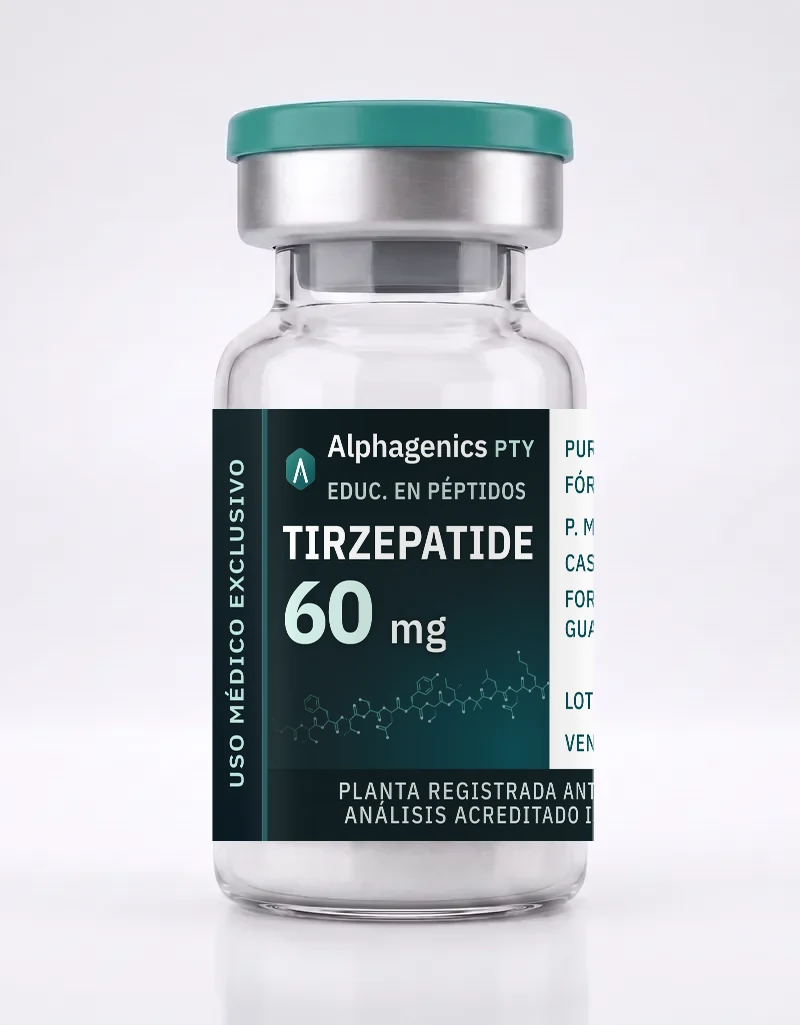
Tirzepatide is a synthetic 39-amino-acid peptide based on the sequence of glucose-dependent insulinotropic polypeptide (GIP), designed to activate both the GIP receptor and the GLP-1 receptor.
It incorporates α-aminoisobutyric acid (Aib) residues at positions 2 and 13 and a C20 fatty diacid chain on lysine 20, which gives it albumin binding and a half-life of about five days. It is the first dual agonist of this class evaluated in large-scale phase 3 clinical programs.
Quick guide · 5 key points
Tirzepatide: two hormone pathways, one molecule
Tirzepatide activates the receptors for two gut hormones, GIP and GLP-1, at the same time. Here are five things the research shows.
-
1
One peptide, two receptors
Tirzepatide is a fatty-acid-modified peptide that activates both the GIP and GLP-1 receptors. In mice, its effect on body weight and food intake was greater than that of a GLP-1-only agonist. In phase 1, its pharmacokinetics supported once-weekly dosing.1
2 receptorsGIP and GLP-1, activated by the same molecule -
2
Average weight loss of up to 20.9%
In the phase 3 SURMOUNT-1 trial (2,539 adults with obesity or overweight, without diabetes, 72 weeks), tirzepatide was associated with average weight reductions of 15.0% to 20.9% depending on dose, compared with 3.1% on placebo. At 15 mg, 57% lost 20% or more.2
−20.9%Average weight change at 15 mg (placebo: −3.1%) -
3
Tested head to head against semaglutide
In SURPASS-2 (1,879 patients with type 2 diabetes, 40 weeks), all three tirzepatide doses were associated with a larger HbA1c reduction and more weight loss than semaglutide 1 mg.3
Semaglutide 1 mgHbA1c −1.86 percentage points over 40 weeks.Tirzepatide 5–15 mgHbA1c −2.01 to −2.30 percentage points over 40 weeks.−5.5 kgExtra weight lost at 15 mg versus semaglutide -
4
Results in sleep apnea and heart failure
In SURMOUNT-OSA (adults with moderate-to-severe obstructive sleep apnea and obesity), the apnea-hypopnea index fell by 25.3 events per hour, versus 5.3 on placebo (trial 1). In SUMMIT (731 patients with heart failure with preserved ejection fraction and obesity), a lower risk of the combined endpoint of cardiovascular death or worsening heart failure was observed (9.9% versus 15.3%), with fewer worsening heart-failure events; cardiovascular deaths were few in both groups.4,5
−25.3Apnea events per hour in SURMOUNT-OSA (placebo: −5.3) -
5
Digestive side effects, mostly while the dose rises
In SURMOUNT-1, the most common side effects were gastrointestinal, mostly mild to moderate and concentrated in the dose-escalation period. Between 4.3% and 7.1% stopped treatment because of side effects (2.6% on placebo). In SURPASS-2, nausea affected 17–22%.2,3
17–22%Had nausea in SURPASS-2 (18% with semaglutide)
References
- Coskun T, et al. LY3298176, a novel dual GIP and GLP-1 receptor agonist for the treatment of type 2 diabetes mellitus: from discovery to clinical proof of concept. Mol Metab. 2018;18:3-14. PMID 30473097
- Jastreboff AM, et al. Tirzepatide once weekly for the treatment of obesity. N Engl J Med. 2022;387(3):205-16. PMID 35658024
- Frías JP, et al. Tirzepatide versus semaglutide once weekly in patients with type 2 diabetes. N Engl J Med. 2021;385(6):503-15. PMID 34170647
- Malhotra A, et al. Tirzepatide for the treatment of obstructive sleep apnea and obesity. N Engl J Med. 2024;391(13):1193-205. PMID 38912654
- Packer M, et al. Tirzepatide for heart failure with preserved ejection fraction and obesity. N Engl J Med. 2025;392(5):427-37. PMID 39555826
Structure and sequence
Sequence
Large molecule (4813.5 g/mol): the full structure is shown above; the sequence summarizes its amino-acid order. 3D model available on PubChem.

Five findings from studies
Summary of results reported in the scientific literature. Each finding describes what was observed in the cited study, in its specific population and conditions; it does not constitute a therapeutic indication.
-
Clinical study
In the SURMOUNT-1 trial (2,539 adults with obesity or overweight, 72 weeks), tirzepatide has shown a mean body-weight reduction of up to 20.9% with the 15 mg dose, versus 3.1% with placebo.
Jastreboff AM et al. N Engl J Med. 2022;387:205-216 (SURMOUNT-1) · PMID 35658024 -
Clinical study
In the SURPASS-2 trial (1,879 patients with type 2 diabetes), an HbA1c reduction greater than that of semaglutide 1 mg has been shown at all three doses evaluated.
Frías JP et al. N Engl J Med. 2021;385:503-515 (SURPASS-2) · PMID 34170647 -
Clinical study
In the SURMOUNT-OSA trials, a significant reduction in the apnea-hypopnea index has been observed in adults with moderate-to-severe obstructive sleep apnea and obesity.
Malhotra A et al. N Engl J Med. 2024;391:1193-1205 (SURMOUNT-OSA) · PMID 38912654 -
Clinical study
In the SUMMIT trial (731 patients with heart failure with preserved ejection fraction and obesity, median follow-up 104 weeks), a reduction in the composite of cardiovascular death or worsening heart failure has been shown (9.9% versus 15.3%; hazard ratio 0.62), with fewer worsening heart-failure events (8.0% versus 14.2%); cardiovascular deaths were few in both groups (2.2% with tirzepatide and 1.4% with placebo).
Packer M et al. N Engl J Med. 2025;392:427-437 (SUMMIT) · PMID 39555826 -
Clinical study
In the phase 2 SYNERGY-NASH trial, resolution of metabolic dysfunction-associated steatohepatitis (MASH) without worsening of fibrosis has been observed in a significantly greater proportion of patients than with placebo.
Loomba R et al. N Engl J Med. 2024;391:299-310 (SYNERGY-NASH) · PMID 38856224