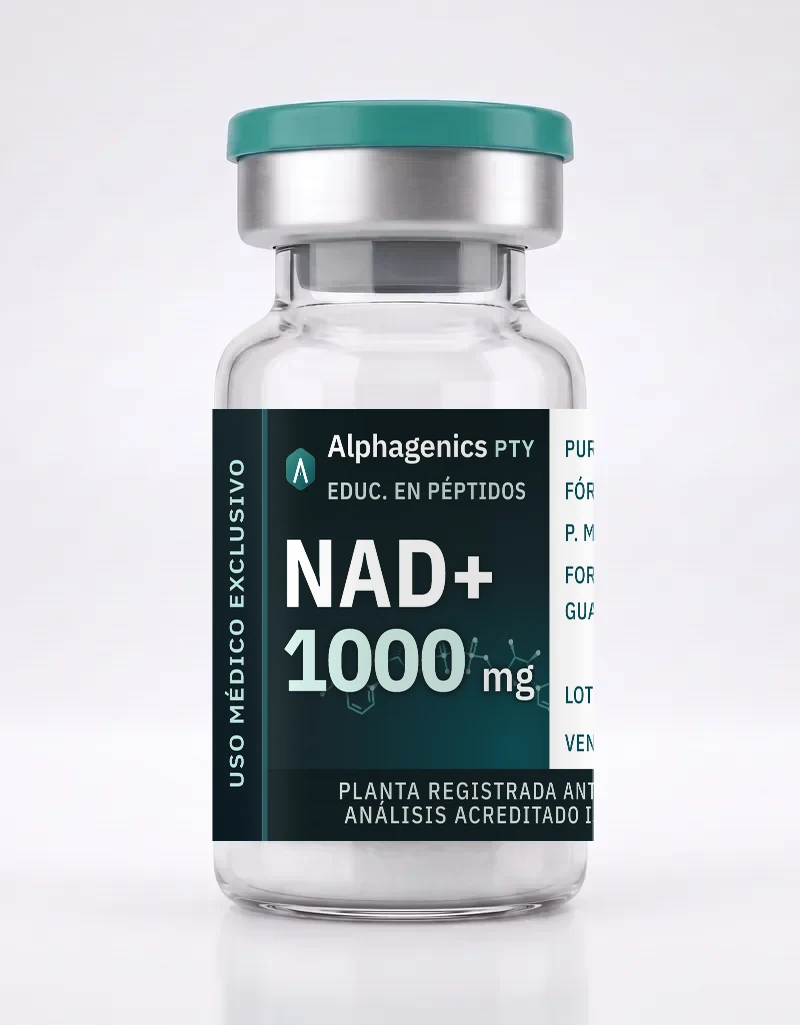
NAD+
Nicotinamide adenine dinucleotide · β-NAD⁺
Redox coenzyme (dinucleotide)
About NAD+
NAD⁺ (nicotinamide adenine dinucleotide) is a coenzyme present in all living cells, essential for the redox reactions of energy metabolism (glycolysis, the Krebs cycle and oxidative phosphorylation).
It is also the substrate of regulatory enzymes such as the sirtuins, the PARPs (DNA repair) and CD38. A decline in NAD⁺ levels with age has been described in various tissues (mostly in animal models and, to a lesser extent, in human tissue), which has prompted an intense line of research into replenishing it, directly or through precursors such as nicotinamide riboside (NR) and nicotinamide mononucleotide (NMN).
Quick guide · 5 key points
NAD+, cellular energy and aging
NAD+ is a coenzyme the mitochondria need to make energy, and that DNA-repair enzymes depend on. Here are five things the research shows.
-
1
The coenzyme of energy and repair
NAD⁺ carries electrons in mitochondrial respiration. It is also the only substrate for PARP, which repairs DNA, and for the sirtuins, enzymes that regulate genes and metabolism. When PARP is over-activated by DNA damage, it uses up NAD⁺.1
PARP · SIRTRepair and regulatory enzymes that consume NAD⁺ -
2
It declines with age in human tissue
In skin samples from 49 people aged 0 to 77, there was a strong negative correlation between NAD⁺ and age in both sexes. In men, NAD⁺ was lower the higher PARP activity was.1
r = −0.71Correlation between NAD⁺ and age in men's skin -
3
IV NAD⁺ is cleared from plasma fast
In a pilot study in healthy men given a 6-hour intravenous NAD⁺ infusion, plasma NAD⁺ did not change for the first 2 hours: it was removed quickly and completely. Urinary excretion of NAD⁺ and methylnicotinamide rose later.2
2 hwith no rise in plasma NAD⁺ during the infusion -
4
The precursors NR and NMN raise NAD⁺
A systematic review of 33 human intervention studies found that oral NR and NMN raise NAD⁺ markers and are well tolerated, but with variable or null functional effects. In postmenopausal women with prediabetes and overweight, NMN was associated with better muscle insulin sensitivity after 10 weeks.5,3,4
33human intervention studies in the systematic review -
5
Injected NAD⁺: tolerability and limited evidence
According to that systematic review, no clinical outcome trial has tested intravenous or intramuscular NAD⁺ itself for anti-aging or wellness. In a retrospective review, NAD⁺ infusion was associated with digestive symptoms, a faster heart rate and chest pressure during the infusion, which resolved once it ended.5,6
97 minAverage NAD⁺ infusion time (37 min for NR)
References
- Massudi H, et al. Age-associated changes in oxidative stress and NAD+ metabolism in human tissue. PLoS One. 2012;7(7):e42357. PMID 22848760
- Grant R, et al. A pilot study investigating changes in the human plasma and urine NAD+ metabolome during a 6 hour intravenous infusion of NAD. Front Aging Neurosci. 2019;11:257. PMID 31572171
- Yoshino M, et al. Nicotinamide mononucleotide increases muscle insulin sensitivity in prediabetic women. Science. 2021;372(6547):1224-1229. PMID 33888596
- Martens CR, et al. Chronic nicotinamide riboside supplementation is well-tolerated and elevates NAD+ in healthy middle-aged and older adults. Nat Commun. 2018;9(1):1286. PMID 29599478
- Gallagher C, et al. NAD⁺ supplementation for anti-aging and wellness: a PRISMA-guided systematic review of preclinical and clinical evidence. Ageing Res Rev. 2026;116:103057. PMID 41655607
- Reyna K, et al. Intravenous infusion of nicotinamide adenine dinucleotide (NAD+) versus nicotinamide riboside (NR): a retrospective tolerability pilot study in a real-world setting. Front Aging. 2026;7:1652582. PMID 41704678
Structure and sequence
Small non-peptide molecule. 2D structure from its canonical SMILES in PubChem.

Five findings from studies
Summary of results reported in the scientific literature. Each finding describes what was observed in the cited study, in its specific population and conditions; it does not constitute a therapeutic indication.
-
Clinical study
In human skin (49 people aged 0 to 77), an age-associated decline in NAD⁺ levels has been observed, together with an increase in DNA damage; in men, NAD⁺ was lower the higher PARP activity was.
Massudi H et al. PLoS One. 2012;7:e42357 · PMID 22848760 -
Clinical study
In a pilot study in healthy men aged 30 to 55, plasma NAD⁺ and its metabolites did not change during the first 2 hours of a 6-hour intravenous NAD⁺ infusion; urinary excretion of NAD⁺ and methylnicotinamide later increased.
Grant R et al. Front Aging Neurosci. 2019;11:257 · PMID 31572171 -
Clinical study
In a 10-week randomized trial in postmenopausal women with prediabetes and overweight or obesity, supplementation with the precursor NMN has shown an improvement in muscle insulin sensitivity.
Yoshino M et al. Science. 2021;372:1224-1229 · PMID 33888596 -
Clinical study
In a randomized crossover trial in healthy middle-aged and older adults, the precursor NR was well tolerated and raised NAD⁺ in peripheral blood mononuclear cells by about 60%; the trend toward lower blood pressure was not statistically significant.
Martens CR et al. Nat Commun. 2018;9:1286 · PMID 29599478 -
Clinical study
In older men, the precursor NR has increased the muscle NAD⁺ metabolome and has been associated with a reduction in circulating inflammatory cytokines.
Elhassan YS et al. Cell Rep. 2019;28:1717-1728 · PMID 31412242