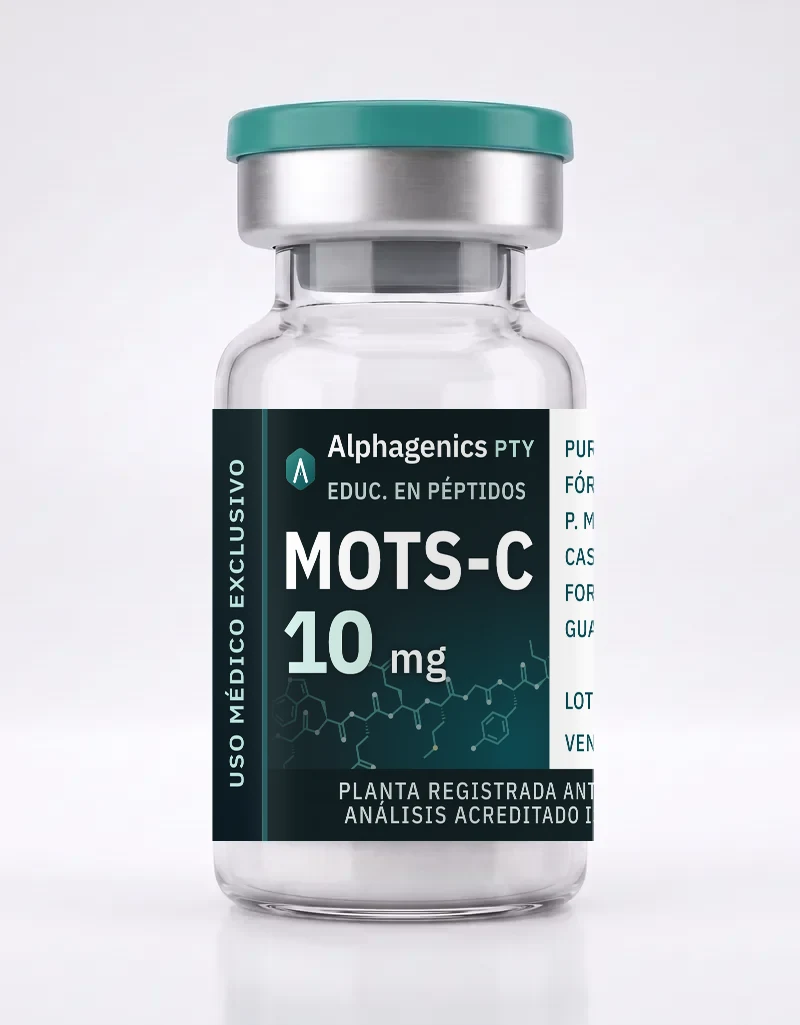
MOTS-c
Mitochondrial ORF of the 12S rRNA type-c
Mitochondrial-derived peptide (MDP)
About MOTS-c
MOTS-c is a 16-amino-acid peptide encoded in mitochondrial DNA, within the 12S ribosomal RNA gene.
It belongs to the family of mitochondrial-derived peptides, which act as signals between the mitochondria and the rest of the cell. It has been described as activating the AMPK pathway and, under metabolic stress, translocating to the nucleus to regulate the expression of stress-response genes. Its circulating levels decline with age and rise with exercise.
Quick guide · 5 key points
MOTS-c, the peptide encoded by mitochondria
MOTS-c is a 16-amino-acid peptide encoded in the mitochondria's own DNA, not in the nucleus. Here are five things the research shows.
-
1
A peptide written in mitochondrial DNA
MOTS-c is encoded in the mitochondrial 12S ribosomal RNA gene. Its main target organ appears to be skeletal muscle, where it has been observed to activate AMPK. Under metabolic stress, it has been observed to move into the nucleus and regulate antioxidant-response genes, together with factors such as NRF2.1,2
16 aaEncoded in mitochondrial DNA, not nuclear DNA -
2
Less obesity and insulin resistance in mice
In mice, MOTS-c treatment has been shown to prevent insulin resistance linked to age and a high-fat diet, as well as diet-induced obesity.1
AMPKThe energy pathway it activates in skeletal muscle -
3
Better physical capacity, and a link to exercise
In young, middle-aged and old mice, MOTS-c was associated with better physical performance. Started at 23.5 months, 3 times a week, it was associated with more physical capacity in old age. In humans, exercise raised the body's own MOTS-c in muscle and blood.3
23.5 moAge of the mice when late-life treatment began -
4
A gene variant linked to diabetes
The m.1382A>C variant, specific to Asian populations, changes one amino acid in MOTS-c. In three cohorts of Japanese ancestry (27,527 people), it was associated with more type 2 diabetes in men, not women. In mice, the variant form lost the metabolic effect.4
27,527people in the meta-analysis of three cohorts -
5
In humans, only observational data
In 225 people, blood MOTS-c was lower in type 2 diabetes and fell with age and HbA1c. The human data are observational (levels and genetics); treatment effects have been seen in animals.5,4,3
225people in the cross-sectional study of blood levels
References
- Lee C, et al. The mitochondrial-derived peptide MOTS-c promotes metabolic homeostasis and reduces obesity and insulin resistance. Cell Metab. 2015;21(3):443-54. PMID 25738459
- Kim KH, et al. The mitochondrial-encoded peptide MOTS-c translocates to the nucleus to regulate nuclear gene expression in response to metabolic stress. Cell Metab. 2018;28(3):516-524.e7. PMID 29983246
- Reynolds JC, et al. MOTS-c is an exercise-induced mitochondrial-encoded regulator of age-dependent physical decline and muscle homeostasis. Nat Commun. 2021;12(1):470. PMID 33473109
- Zempo H, et al. A pro-diabetogenic mtDNA polymorphism in the mitochondrial-derived peptide, MOTS-c. Aging (Albany NY). 2021;13(2):1692-1717. PMID 33468709
- Ramanjaneya M, et al. Mitochondrial-derived peptides are down regulated in diabetes subjects. Front Endocrinol (Lausanne). 2019;10:331. PMID 31214116
Structure and sequence
Sequence

Five findings from studies
Summary of results reported in the scientific literature. Each finding describes what was observed in the cited study, in its specific population and conditions; it does not constitute a therapeutic indication.
-
Preclinical
In mice fed a high-fat diet, MOTS-c has shown prevention of obesity and insulin resistance through activation of AMPK in skeletal muscle.
Lee C et al. Cell Metab. 2015;21:443-454 · PMID 25738459 -
Preclinical
In young and aged mice, MOTS-c has been associated with better physical capacity; in humans, its endogenous levels increased with exercise.
Reynolds JC et al. Nat Commun. 2021;12:470 · PMID 33473109 -
In vitro
In cells under metabolic stress, MOTS-c has been observed to translocate to the nucleus and regulate genes with antioxidant response elements.
Kim KH et al. Cell Metab. 2018;28:516-524 · PMID 29983246 -
Clinical study
In a meta-analysis of three cohorts of Japanese ancestry (n = 27,527), the m.1382A>C variant of the MOTS-c gene has been associated with a higher prevalence of type 2 diabetes in men, but not in women.
Zempo H et al. Aging (Albany NY). 2021;13:1692-1717 · PMID 33468709 -
Clinical study
In a cross-sectional study in 225 people, lower serum MOTS-c levels have been observed in people with type 2 diabetes, with a negative correlation with age and with HbA1c.
Ramanjaneya M et al. Front Endocrinol (Lausanne). 2019;10:331 · PMID 31214116