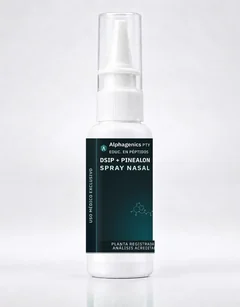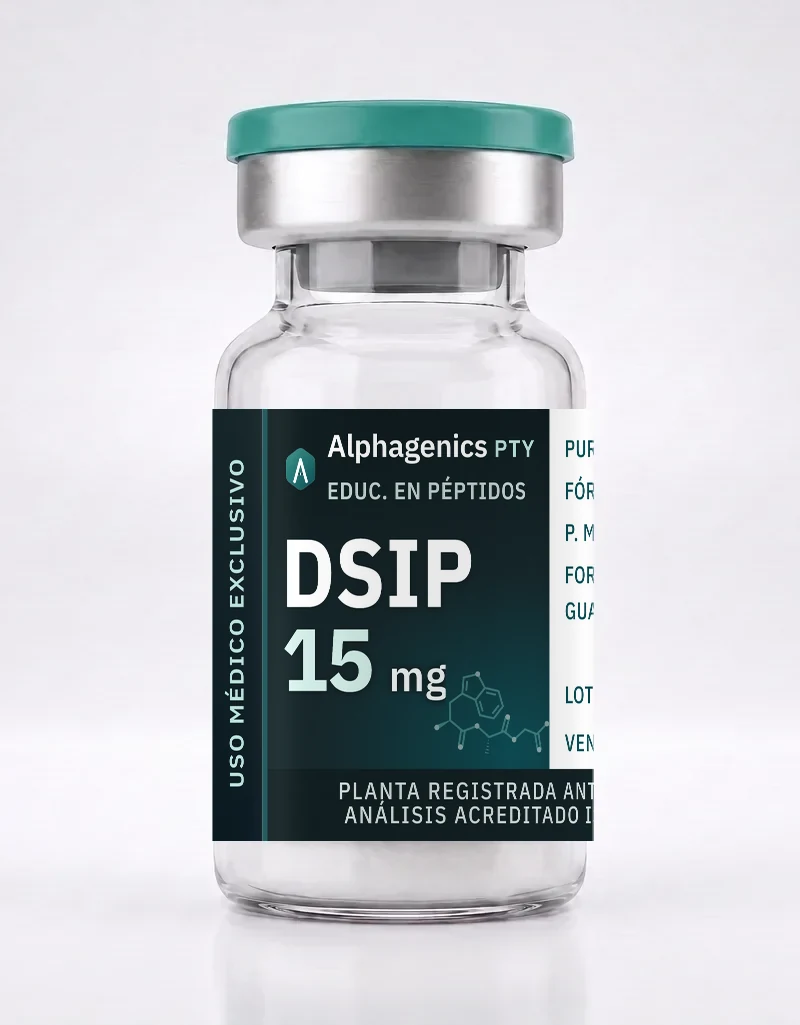
DSIP
Delta sleep-inducing peptide · Emideltide
Neuromodulatory nonapeptide
About DSIP
DSIP (delta sleep-inducing peptide) is a nonapeptide isolated in 1977 from the cerebral venous blood of rabbits in which sleep had been induced by electrical stimulation of the thalamus.
It has been studied for its possible role in the regulation of slow-wave sleep, the stress response and neuroendocrine modulation. Its specific receptor has not been identified, and the results of human studies have been heterogeneous.
Quick guide · 5 key points
DSIP and sleep research
DSIP is a nine-amino-acid peptide first isolated for its link to deep sleep. Here are five things the research shows.
-
1
A nonapeptide found through its effect on EEG
DSIP was isolated in 1977 in rabbits. When infused into the brains of rabbits under double-blind conditions, only synthetic DSIP was associated with a specific increase in delta waves and sleep spindles on EEG, compared with its fragments and analogues.1
1977Year it was characterized; the study evaluated 58 rabbits -
2
Early studies in insomnia
In patients with insomnia, single DSIP injections before sleep were associated with improved sleep. With repeated administrations, a normalization of sleep structure was observed after four doses.2
4administrations before sleep structure normalized in those studies -
3
Controlled trials were more modest
In a double-blind trial of 16 patients with chronic insomnia, DSIP was associated with higher sleep efficiency than placebo, but the authors judged the effects weak and of little clinical benefit. A placebo-controlled crossover trial reached a similar conclusion.3,4
16chronic insomnia patients in a double-blind trial -
4
A very short half-life, yet it reaches the brain
After an intravenous injection in dogs, DSIP cleared quickly from plasma, with a half-life of about 4 minutes (2–3 minutes in a monkey and in rats). In rats, a labeled analogue has been shown to cross the blood-brain barrier.5,6
≈ 4 minPlasma half-life in dogs after an intravenous dose -
5
A mechanism that is still unclear
No DSIP gene or specific receptor has ever been identified, and a 2006 review described its role as a sleep factor as poorly documented. In a study of 107 patients withdrawing from alcohol or opiates, tolerance was good apart from headaches in a few.7,8
No receptorThe DSIP gene and receptor remain unidentified
References
- Schoenenberger GA, Monnier M. Characterization of a delta-electroencephalogram (-sleep)-inducing peptide. Proc Natl Acad Sci U S A. 1977;74(3):1282-6. PMID 265572
- Schneider-Helmert D. DSIP in insomnia. Eur Neurol. 1984;23(5):358-63. PMID 6391925
- Bes F, et al. Effects of delta sleep-inducing peptide on sleep of chronic insomniac patients. A double-blind study. Neuropsychobiology. 1992;26(4):193-7. PMID 1299794
- Monti JM, et al. Study of delta sleep-inducing peptide efficacy in improving sleep on short-term administration to chronic insomniacs. Int J Clin Pharmacol Res. 1987;7(2):105-10. PMID 3583493
- Kato N, et al. Development of an enzyme immunoassay for delta sleep-inducing peptide (DSIP) and its use in the determination of the metabolic clearance rate of DSIP administered to dogs. Neuroendocrinology. 1984;39(1):39-44. PMID 6379493
- Banks WA, et al. Evidence that [125I]N-Tyr-delta sleep-inducing peptide crosses the blood-brain barrier by a non-competitive mechanism. Brain Res. 1984;301(2):201-7. PMID 6547363
- Kovalzon VM, et al. Delta sleep-inducing peptide (DSIP): a still unresolved riddle. J Neurochem. 2006;97(2):303-9. PMID 16539679
- Dick P, et al. DSIP in the treatment of withdrawal syndromes from alcohol and opiates. Eur Neurol. 1984;23(5):364-71. PMID 6548969
Structure and sequence
Sequence

Five findings from studies
Summary of results reported in the scientific literature. Each finding describes what was observed in the cited study, in its specific population and conditions; it does not constitute a therapeutic indication.
-
Preclinical
In the original studies in rabbits, isolated DSIP has shown an increase in slow-wave (delta) electroencephalographic activity and in sleep spindles.
Schoenenberger GA, Monnier M. Proc Natl Acad Sci U S A. 1977;74:1282-1286 · PMID 265572 -
Clinical study
In patients with insomnia, administration of DSIP has been associated with improved sleep, with a normalization of its structure after several administrations.
Schneider-Helmert D. Eur Neurol. 1984;23:358-363 · PMID 6391925 -
Clinical study
In 107 inpatients with alcohol or opiate withdrawal syndrome, intravenous DSIP has been associated, on clinical assessment, with an attenuation of withdrawal symptoms.
Dick P et al. Eur Neurol. 1984;23:364-371 · PMID 6548969 -
Preclinical
In rats subjected to hypoxia, pretreatment with DSIP has been associated with preservation of the respiratory activity of brain mitochondria, which suggests a protective effect against stress.
Khvatova EM et al. Peptides. 2003;24:307-311 · PMID 12668217 -
Preclinical
In studies in rats and dogs, a radiolabeled DSIP analog has been observed to cross the blood-brain barrier and the blood-CSF barrier through a non-competitive mechanism.
Banks WA et al. Brain Res. 1984;301:201-207 · PMID 6547363