BPC-157
10 mgG1E2P3P4P5G6K7P8A9D10D11A12G13L14V15
- Molecular formula
- C62H98N16O22
- Molecular weight
- 1419.5 g/mol
- CAS number
- 137525-51-0
- PubChem CID
- 9941957
- Length
- 15 aa
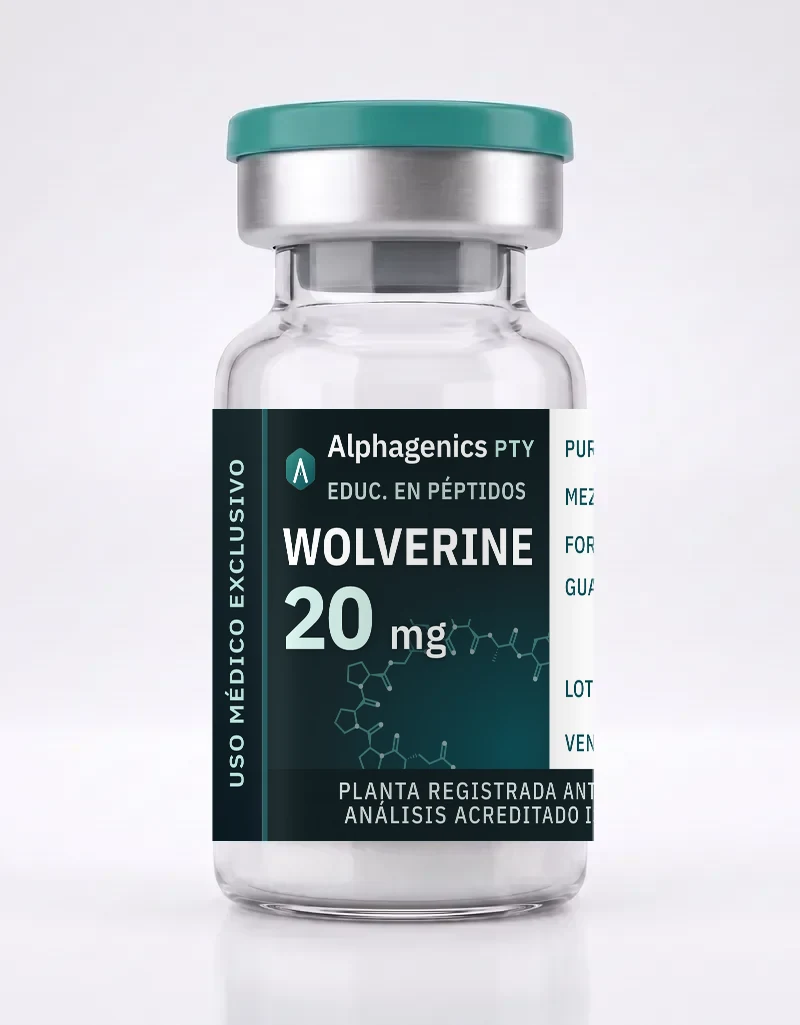
BPC-157 + TB-500
Combination of research peptides in tissue recovery
Wolverine combines BPC-157 and TB-500, two peptides studied mostly in animal models of soft-tissue injury.
BPC-157 has been associated with angiogenesis, with VEGFR2 activation, and with tendon fibroblast migration. Two molecules are sold under the name TB-500: the synthetic N-acetylated 17-23 fragment of thymosin β4 (Ac-LKKTETQ, short chain), which corresponds to its actin-binding domain, and full-length 43-amino-acid thymosin β4 (long chain); the form present in each lot is stated on its certificate of analysis. Most published data on thymosin β4 come from the full-length protein, and each finding states which molecule was studied. In the only published study of the combination that was found (rats with Achilles tendon repair), the combination showed no added benefit over either peptide alone.
Quick guide · 5 key points
Wolverine combines BPC-157 and TB-500 (short-chain fragment or full-length thymosin β4, depending on the lot), studied mostly in animal models of tissue injury. Five points from the research.
BPC-157 has been associated with tendon fibroblast migration and VEGFR2 activation (new vessel formation). TB-500, depending on the lot, is the Ac-LKKTETQ fragment (short chain) or full-length thymosin β4 (long chain). Almost all the evidence is for each component on its own.1,2,3
In rats with a transected Achilles tendon, BPC-157 has been associated with better functional, biomechanical and histological recovery, with higher load to failure and better collagen formation than in controls.4
In aged mice, the synthetic peptide LKKTETQ (short-chain TB-500 without acetylation) has been associated with dermal wound repair comparable to that of full-length thymosin β4. In human serum in vitro and in rats, short-chain TB-500 was metabolized into shorter fragments; in fibroblasts, only the metabolite Ac-LKKTE showed significant wound closure versus control.5,6
In 32 rats with Achilles tendon repair, TB-500 (described as synthetic thymosin β4, form not stated) was associated with better histological tendon organization and higher load to failure at 4 weeks; BPC-157 showed numerically better scores, without significance for the total scores. The combination showed no added benefit over either peptide alone.7
In an uncontrolled retrospective series, 3 of 4 patients who received BPC-157 and thymosin β4 (TB4, form not specified) in the knee reported pain relief. A systematic review found no clinical safety data for BPC-157. Full-length intravenous thymosin β4 was well tolerated in phase 1 (40 healthy volunteers); no clinical trials with the fragment were found.8,9,10
Reference amounts of the formulation. The physicochemical data correspond to each individual peptide.
Summary of results reported in the scientific literature. Each finding describes what was observed in the cited study, in its specific population and conditions; it does not constitute a therapeutic indication.
BPC-157: in a rat Achilles tendon transection model it has been associated with better functional, biomechanical and histological recovery.
Staresinic M et al. J Orthop Res. 2003;21:976-983 · PMID 14554208BPC-157: in tendon fibroblasts it has shown increased cell migration, likely mediated by the FAK-paxillin pathway.
Chang CH et al. J Appl Physiol (1985). 2011;110:774-780 · PMID 21030672TB-500 short chain (LKKTETQ fragment): in aged mice, the synthetic heptapeptide LKKTETQ (the sequence of short-chain TB-500, without the N-terminal acetylation), which reproduces the actin-binding domain of thymosin β4, has been associated with dermal wound repair comparable to that of full-length thymosin β4.
Philp D et al. Wound Repair Regen. 2003;11:19-24 · PMID 12581423BPC-157 + TB-500 (form not specified): in 32 rats with Achilles tendon repair, TB-500 (a commercial product the authors describe as synthetic thymosin β4, without stating whether it was the short-chain fragment or the full-length protein) has been associated with higher maximum load to failure and better histological scores at 4 weeks; BPC-157 showed numerical improvements without significance in total scores, and the combination showed no added benefit over either peptide alone.
Biçer O et al. Jt Dis Relat Surg. 2026;37:822-837 · PMID 42542926TB-500 short chain (Ac-LKKTETQ): in human serum in vitro and in rats, TB-500 was metabolized into shorter fragments (in rats, mainly Ac-LK); in fibroblasts, only the metabolite Ac-LKKTE showed significant wound-closure activity versus control, and the authors suggest that the activity attributed to TB-500 may be due to this metabolite.
Rahaman KA et al. J Chromatogr B Analyt Technol Biomed Life Sci. 2024;1235:124033 · PMID 38382158