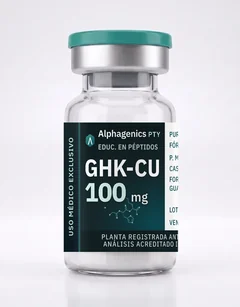
GHK-Cu
50 / 70 mgGlyHisLys · Cu²⁺
- Molecular formula
- C14H22CuN6O4
- Molecular weight
- 401.9 g/mol
- CAS number
- 89030-95-5
- PubChem CID
- 71587328
- Length
- 3 aa + Cu
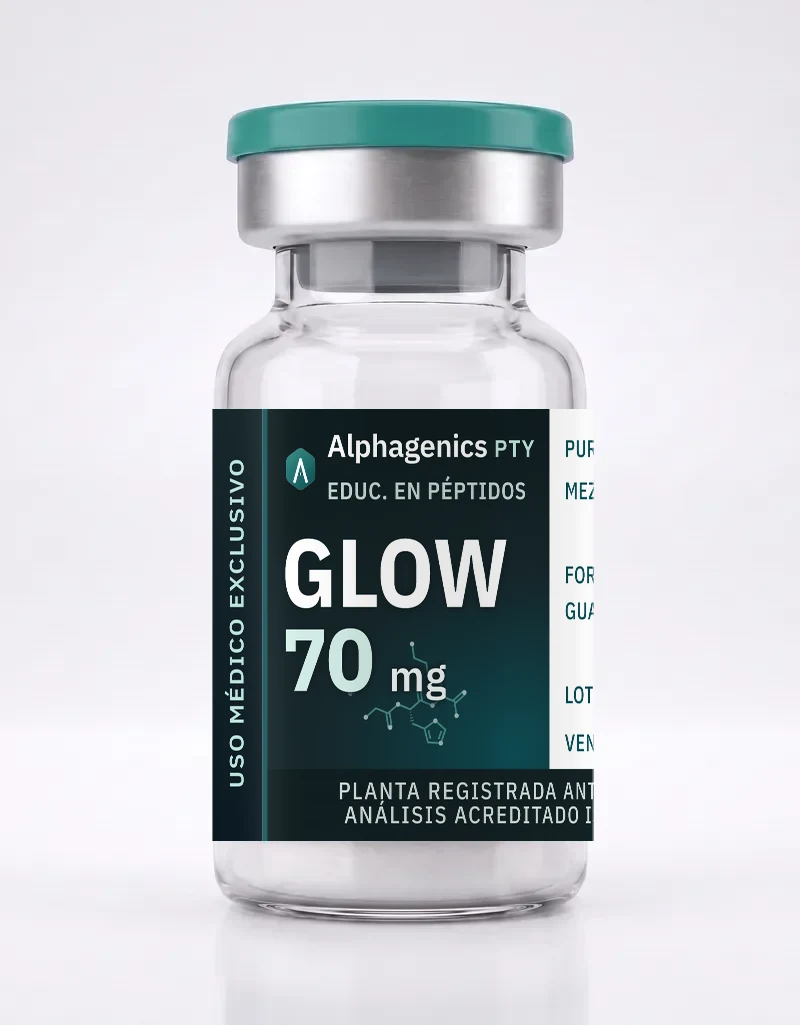
GHK-Cu + BPC-157 + TB-500
Combination of research peptides in tissue regeneration and skin
GLOW combines three peptides studied in different lines of research on tissue repair.
GHK-Cu has been studied for its relationship with collagen synthesis and extracellular matrix remodeling; BPC-157, for its association with angiogenesis and soft-tissue healing; and TB-500, for its relationship with cell migration and wound healing. Two molecules are sold under the name TB-500: the synthetic N-acetylated fragment Ac-LKKTETQ (thymosin β4 sequence 17-23, short chain) and full-length 43-amino-acid thymosin β4 (long chain); the form present in each lot is stated on its certificate of analysis, and each finding states which molecule was studied. No published studies of the three-peptide blend were found; the evidence refers to each component on its own. Each component keeps its own physicochemical data, detailed below.
Quick guide · 5 key points
GLOW combines three peptides studied in different stages of tissue repair: collagen, blood vessels and cell migration. Here are five things the research shows.
GHK-Cu has been studied for collagen synthesis; BPC-157, derived from a protein in human gastric juice, for blood vessels and tendons; and TB-500 (short-chain fragment or full-length thymosin β4, depending on the lot), for cell migration and wound closure. The published evidence is for each component on its own, not for the blend.1,3,11
In human fibroblasts, GHK-Cu has been associated with more collagen synthesis at nanomolar concentrations. In wound chambers implanted under the skin of rats, it was associated with a concentration-dependent rise in collagen and glycosaminoglycans; collagen synthesis was stimulated twice as much as that of other proteins.1,2
In rat tendon fibroblasts, BPC-157 has been associated with more cell migration and better survival under oxidative stress. In rats with hind-limb ischemia, studies observed faster recovery of blood flow and more vessels, along with activation of the VEGFR2 receptor.3,4
TB-500 can be the short chain, the N-acetylated form of LKKTETQ (thymosin β4 sequence 17-23, with its actin-binding domain), or the long chain, full-length 43-amino-acid thymosin β4. Short chain: in aged mice, the synthetic peptide LKKTETQ (non-acetylated) has been associated with dermal wound repair comparable to that of full-length thymosin β4. Most published data (e.g., +61% re-epithelialization in rats) come from the long chain.11,10,5
A study in 32 rats with a repaired Achilles tendon tested BPC-157 + TB-500 (form not specified): the combination added no benefit over either one alone. Full-length thymosin β4 (long chain, not the fragment) reached phase 2 trials in skin ulcers; for BPC-157, a 2025 review found only three pilot studies in humans. No published study of all three together was found.9,6,7,8
Reference amounts of the formulation. The physicochemical data correspond to each individual peptide.
Summary of results reported in the scientific literature. Each finding describes what was observed in the cited study, in its specific population and conditions; it does not constitute a therapeutic indication.
GHK-Cu: in human fibroblasts it has shown increased collagen synthesis at nanomolar concentrations.
Maquart FX et al. FEBS Lett. 1988;238:343-346 · PMID 3169264GHK-Cu: in a rat model of subcutaneously implanted wound chambers it has been associated with a concentration-dependent increase in collagen content in the repair tissue.
Maquart FX et al. J Clin Invest. 1993;92:2368-2376 · PMID 8227353BPC-157: in tendon fibroblasts it has shown increased cell migration and survival.
Chang CH et al. J Appl Physiol. 2011;110:774-780 · PMID 21030672BPC-157: in a rat hindlimb ischemia model, faster recovery of blood flow and a greater number of vessels have been observed, associated with VEGFR2 activation.
Hsieh MJ et al. J Mol Med. 2017;95:323-333 · PMID 27847966TB-500 short chain (LKKTETQ fragment): in aged mice, the synthetic heptapeptide LKKTETQ (the sequence of short-chain TB-500, without the N-terminal acetylation), which reproduces the actin-binding domain of thymosin β4, has been associated with dermal wound repair comparable to that of full-length thymosin β4.
Philp D et al. Wound Repair Regen. 2003;11:19-24 · PMID 12581423