PT-141
5 · 20 mgAcNleciclo[Asp-His-D-Phe-Arg-Trp-Lys]OH
- Molecular formula
- C50H68N14O10
- Molecular weight
- 1025.2 g/mol
- CAS number
- 189691-06-3
- PubChem CID
- 9941379
- Length
- 7 aa (cíclico)
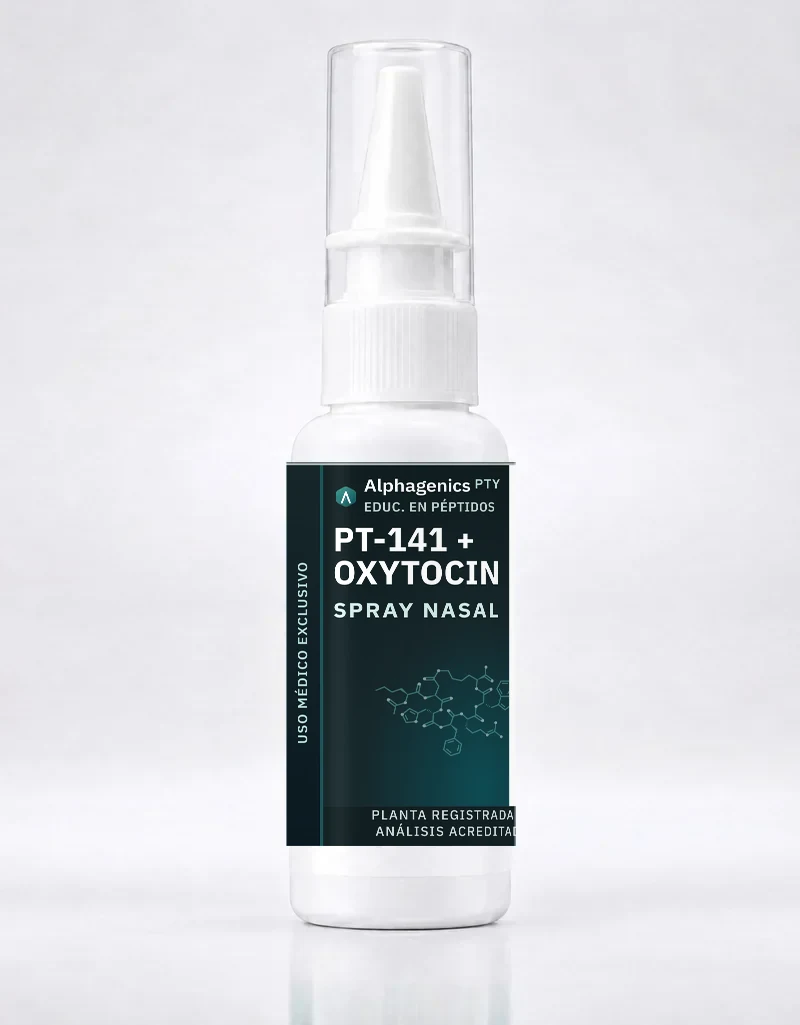
Bremelanotide + Oxytocin
Combination of a melanocortin agonist and a hypothalamic nonapeptide
This spray combines PT-141 (bremelanotide), a melanocortin receptor agonist FDA-approved as a subcutaneous injection for hypoactive sexual desire disorder in premenopausal women, with oxytocin, a hypothalamic nonapeptide studied for its role in bonding and sexual response.
PT-141 has been studied for its central action on desire and arousal; oxytocin for its link to orgasm and contentment afterward.
Quick guide · 5 key points
This spray pairs PT-141 (bremelanotide), studied for its central action on desire and arousal, with oxytocin, studied for its link to orgasm. Here are five things the research shows.
PT-141 is a non-selective melanocortin receptor agonist; according to the FDA label, MC1R and MC4R are the most relevant at therapeutic doses. Oxytocin acts on its own receptor, OXTR. In mice, MC4R signaling on oxytocin neurons was associated with normal ejaculation, a link between the two systems.1,2,3
In the two phase 3 RECONNECT trials, in premenopausal women with hypoactive sexual desire disorder, subcutaneous bremelanotide was associated with a significant increase in desire and less distress than placebo. It was FDA-approved in 2019 (Vyleesi®) as a subcutaneous injection for that indication; it is not approved for use in men.4,1
In healthy men, subcutaneous PT-141 was associated with significant erectile responses measured by RigiScan®, even without visual sexual stimulation. In men with erectile dysfunction and an inadequate response to 100 mg Viagra®, significant responses versus placebo were also observed.5
In a study of 9 healthy men and 13 healthy women, plasma oxytocin rose during arousal and was significantly higher during orgasm than at baseline. The authors link it to smooth muscle contractions of the reproductive tract during orgasm.6
These studies tested each component on its own, not the combination. In animals, oxytocin facilitates sexual behavior, but human studies have not confirmed this. For bremelanotide, the FDA label describes nausea (40%), flushing and headache, and a transient rise in blood pressure after each dose.7,8,1
Reference amounts of the formulation. The physicochemical data correspond to each individual peptide.
Summary of results reported in the scientific literature. Each finding describes what was observed in the cited study, in its specific population and conditions; it does not constitute a therapeutic indication.
PT-141: in the phase 3 RECONNECT trials (more than 1,200 premenopausal women with hypoactive sexual desire disorder), an improvement in sexual desire and a reduction in associated distress versus placebo have been shown.
Kingsberg SA et al. Obstet Gynecol. 2019;134:899-908 · PMID 31599840PT-141: bremelanotide has received FDA approval (2019), as a subcutaneous injection, for acquired, generalized hypoactive sexual desire disorder in premenopausal women.
FDA. Vyleesi (bremelanotide) — prescribing information, NDA 210557PT-141: in healthy men and in men with mild-to-moderate erectile dysfunction, intranasal PT-141 has been associated with an erectile response significantly greater than placebo at doses above 7 mg.
Diamond LE et al. Int J Impot Res. 2004;16:51-59 · PMID 14963471Oxytocin: in 29 healthy couples, 24 IU of intranasal oxytocin did not change drive or arousal, but was associated with greater orgasm intensity and greater contentment after intercourse.
Behnia B et al. Horm Behav. 2014;65:308-318 · PMID 24503174Oxytocin: in a review of 38 trials (1,529 participants) using 18–40 IU intranasally in the short term, side effects did not differ from placebo.
MacDonald E et al. Psychoneuroendocrinology. 2011;36:1114-1126 · PMID 21429671