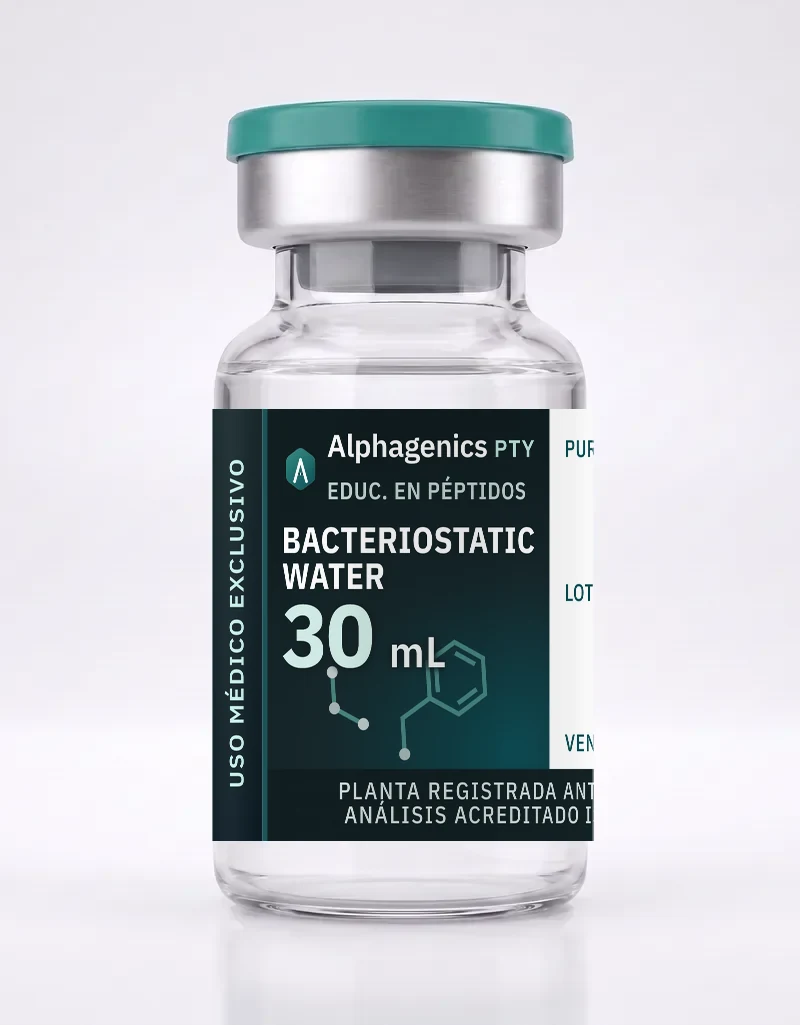
Bacteriostatic Water
Bacteriostatic Water for Injection, USP
Sterile diluent with preservative (0.9% benzyl alcohol)
About Bacteriostatic Water
Bacteriostatic water is sterile water for injection that contains 0.9% benzyl alcohol (9 mg/mL) as a bacteriostatic agent.
The preservative has bacteriostatic action, which allows several doses to be withdrawn from the same vial over a limited period. It is used as a diluent for the reconstitution of lyophilized peptides and other compatible medications.
Quick guide · 5 key points
Bacteriostatic Water: the essentials
Bacteriostatic water is sterile water for injection with a preservative that allows several doses to be drawn from the same vial. Five key facts from the label and the literature.
-
1
Sterile water with a preservative
Per the USP, it is sterilized water for injection that contains one or more antimicrobial agents. On the approved label, the preservative is 0.9% benzyl alcohol (9 mg/mL) (the label also covers a 1.1% version), at a pH of 5.7 (4.5 to 7.0), in a multiple-dose container.1,2
0.9%Benzyl alcohol (9 mg/mL) as a bacteriostatic preservative -
2
Why the preservative matters
A 1,300-bed German hospital tested 227 multiple-dose vials in use: 0.9% were contaminated and 109 held medications with no preservative. The authors advised against using preservative-free medications as multiple-dose vials.3
227In-use multiple-dose vials tested on a single day -
3
The 28-day rule
Per the CDC, a multiple-dose vial that has been opened or punctured should be dated and discarded within 28 days, unless the manufacturer states another date. Before opening, the label calls for storage at 20–25 °C.4,2
28 daysMaximum time after a multiple-dose vial is punctured -
4
Not for newborns
The label carries a boxed warning: not for use in neonates, because benzyl alcohol has been associated with toxicity in them. Its link to the "gasping syndrome" was described in 1982. For neonates, the label calls for preservative-free sterile water.2,5
NeonatesPopulation excluded by the label's boxed warning -
5
A diluent only
The label limits it to diluting or dissolving drugs for injection. Given intravenously without a solute it may cause hemolysis; it must be made roughly isotonic, and it is not for fluid replacement or epidural or spinal anesthesia. Some drugs are incompatible with benzyl alcohol.2
DiluentThe only use listed on the label
References
- United States Pharmacopeia. USP Monographs: Bacteriostatic Water for Injection. USP-NF. Rockville, MD: USP; 2017. Official source
- U.S. National Library of Medicine. DailyMed: Bacteriostatic Water for Injection, USP, 30 mL multiple-dose vial (NDA 018802). Prescribing information, revised 10/2025. Official source
- Mattner F, Gastmeier P. Bacterial contamination of multiple-dose vials: a prevalence study. Am J Infect Control. 2004;32(1):12-6. PMID 14755229
- Centers for Disease Control and Prevention. Preventing unsafe injection practices: multi-dose vials. Injection Safety. Official source
- Gershanik J, et al. The gasping syndrome and benzyl alcohol poisoning. N Engl J Med. 1982;307(22):1384-8. PMID 7133084
Structure and sequence
Structure of the preservative, benzyl alcohol (C7H8O), present at 0.9% w/v in sterile water for injection.
Five findings from studies
Summary of results reported in the scientific literature. Each finding describes what was observed in the cited study, in its specific population and conditions; it does not constitute a therapeutic indication.
-
Regulatory
According to the USP monograph, bacteriostatic water for injection is sterilized, suitably packaged water for injection that contains one or more suitable antimicrobial agents.
United States Pharmacopeia. Monograph: Bacteriostatic Water for Injection -
Regulatory
According to the FDA-approved label, bacteriostatic water for injection contains 0.9% (9 mg/mL) benzyl alcohol added as a bacteriostatic preservative, in a multiple-dose container from which repeated withdrawals may be made.
DailyMed (NLM). Bacteriostatic Water for Injection, USP (NDA 018802). Prescribing information, rev. 10/2025 -
Clinical study
In a prevalence study in a 1,300-bed hospital, 0.9% of the multiple-dose vials in use showed bacterial contamination; the authors recommend not using preservative-free medications as multiple-dose.
Mattner F, Gastmeier P. Am J Infect Control. 2004;32:12-16 · PMID 14755229 -
Regulatory
According to the CDC, a multiple-dose vial that has been opened or punctured should be dated and discarded within 28 days, unless the manufacturer states another date.
Centers for Disease Control and Prevention (CDC). Preventing unsafe injection practices: multi-dose vials -
Clinical study
Benzyl alcohol should not be used in neonates: in premature newborns, its intravenous administration has been associated with "gasping syndrome".
Gershanik J et al. N Engl J Med. 1982;307:1384-1388 · PMID 7133084